
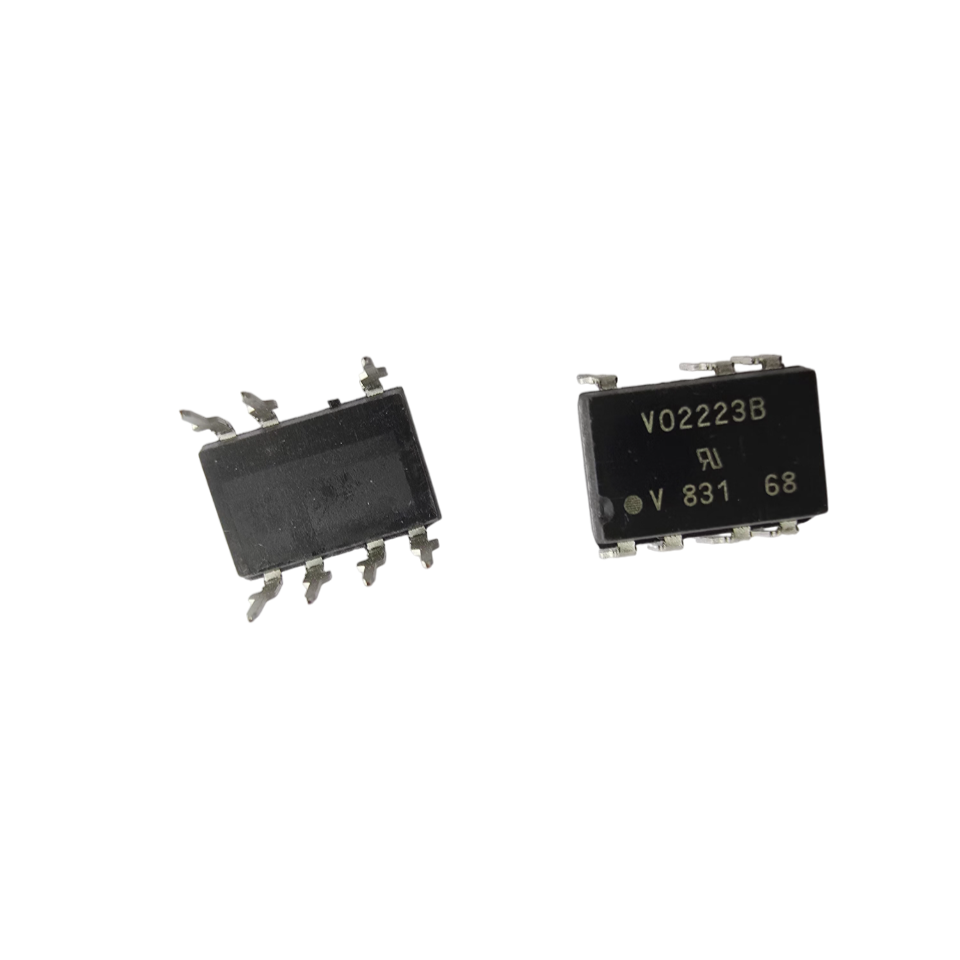
Overview
The VO2223B from Vishay is a non-zero crossing (nZC) power phototriac optocoupler designed to isolate and control AC mains or medium voltage AC loads via a low-voltage input signal. It features an integrated power TRIAC output, eliminating the need for a separate external TRIAC in many applications. With a high blocking voltage rating (600 V) and the ability to handle 1 A RMS load current, the VO2223B is suitable for driving moderate AC loads, while providing galvanic and noise isolation between control and load domains.
The device supports rapid switching with a dV/dt tolerance of 600 V/µs, making it robust against transient voltage changes. It is packaged in a standard DIP-8 form, facilitating through-hole mounting in traditional PCB designs.
The VO2223B is certified under safety agencies like UL 1577, cUL, and VDE (per DIN EN 60747-5-5), making it suitable for use in regulated systems.
Key Features & Specifications
| Parameter | Value / Characteristic |
|---|---|
| Manufacturer | Vishay |
| Manufacturer Part Number | VO2223B |
| Optocoupler Type | Power Phototriac (nZC) |
| Package | DIP-8 |
| Input / LED Forward Current (max) | 50 mA (absolute max) |
| Input Reverse Voltage | 5 V (max) |
| Peak Off-State Voltage (blocking) | 600 V (V_DR M) |
| RMS On-State Current | 1 A |
| Surge / Non-repetitive On-State Current | 10 A (50 Hz peak) |
| dV/dt (minimum) | 600 V/µs |
| Isolation Voltage (Input-to-Output) | 5,300 VRMS test |
| Power Dissipation (output) | ~1,130 mW (typical) |
| Ambient Operating Temperature | –40 °C to +85 °C |
| Storage Temperature | –40 °C to +150 °C |
| Soldering Temperature | 260 °C (≤ 10 s) |
| Safety / Agency Approvals | UL 1577, cUL, VDE (DIN EN 60747-5-5), FIMKO |
Applications & Use-Cases
The VO2223B is well suited for many AC load switching or isolation tasks, especially in environmen
ts where compactness, safety isolation, and reliable switching are required:
-
Home appliances & consumer electronics — for controlling heaters, fans, motors, or resistive loads in washing machines, microwave ovens, air conditioners, etc.
-
HVAC and climate control systems — to drive AC actuators or valves with isolation from control logic
-
Industrial automation — for AC load switching (solenoids, small motors, relays) in PLC or control modules
-
Lighting control — for switching mains lighting circuits (resistive or inductive) via a microcontroller or digital logic
-
Office and commercial equipment — e.g. controlling heaters, AC loads, or other mains devices in printers, copiers, etc
-
Isolation for safety / protection — where galvanic isolation is needed between control electronics and high-voltage AC lines
Reviews
There are no reviews yet.